Cavqelorex
Luma Guide
Luma Guide
Couldn't load pickup availability
1. Problem Statement
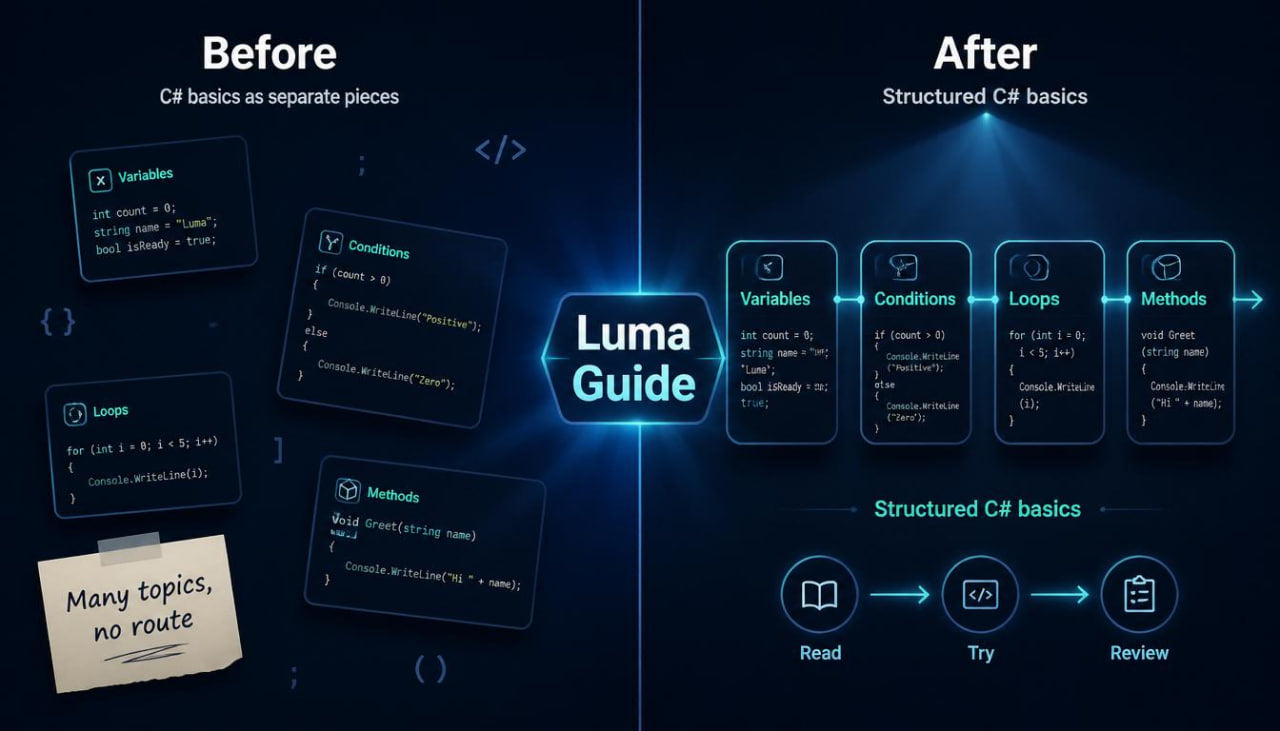
After a first look at C#, learners often need more than scattered notes or isolated examples. They may understand a single line of code, but feel unsure when several lines begin working together. Basic topics such as variables, conditions, loops, and methods can become confusing when they are introduced without a clear order. Many learners also struggle to connect theory with small writing exercises. Luma Guide was created to give early C# study a more organized shape.
2. Solution
Luma Guide gives learners a guided path through the early building blocks of C#. The materials move from simple code reading into small writing tasks, helping learners notice how syntax and logic connect. Each section introduces one topic, shows a focused example, and then gives a practical task for review. The tone stays clear and grounded, with no inflated claims about personal or career outcomes. This tier supports learners who want more structure after the first Cavqelorex sample.
3. What’s Inside
Luma Guide includes a broader set of C# learning materials arranged for early-stage study. The first section introduces the shape of a basic C# file, showing how names, brackets, statements, and method calls sit together. Instead of presenting code as a large block, the materials break it into smaller parts and explain what each part contributes.
The next section focuses on variables and simple data types. Learners review how values are named, stored, updated, and used inside small examples. This part also includes comparison notes, so learners can see how different value types appear in real code snippets.
Another section introduces conditions. Learners study simple decision-making code, including if statements and comparison logic. The examples are intentionally small, allowing attention to stay on how a condition is written and how the code path changes.
Luma Guide also introduces loops through carefully arranged examples. Learners review repeated actions, counters, and simple collections of values. Practice tasks ask learners to predict what a loop will do before reading the explanation.
A later section covers methods as reusable blocks of code. Learners study method names, parameters, return values, and the reason code is often separated into smaller parts. This helps learners begin thinking about organization, not only syntax.
The tier also includes review prompts, short coding exercises, and reflection questions. These materials help learners pause, describe what they see, and revise small code samples with more care.
4. Who Is This For?
Luma Guide is for learners who have seen C# basics and want a more structured learning route. It works well for people who prefer clear explanations, practical examples, and small tasks that build gradually. It is also suitable for learners returning to C# after a break and wanting a calm review of core topics. This tier is not built around dramatic claims; it is built around steady study.
5. What You’ll Learn
- How basic C# files are organized
- How variables and simple data types work in small examples
- How conditions guide code behavior
- How loops repeat actions and process values
- How methods help divide code into readable parts
- How to review short code snippets before writing your own
- How to connect syntax with practical coding tasks
- How to follow a structured C# study routine
6. 30-Day Refund Note
Luma Guide includes a 30-day refund window according to Cavqelorex store terms. Learners may review the materials and request a refund within that period if the tier does not match their study needs. This refund note describes store terms only and does not make claims about learning outcomes.
- 📄 Digital file available after purchase
- 🗂️ Long-term availability
- 🔐 Secure checkout
- 🛠️ Content updated in 2026
Self-paced learning overview
What is included in each Cavqelorex C# tier?
What is included in each Cavqelorex C# tier?
Each tier includes structured C# learning materials arranged around topics, examples, and practice tasks. Higher tiers add broader topic coverage, deeper explanations, and more guided coding exercises.
Do I need prior coding knowledge?
Do I need prior coding knowledge?
Some tiers are made for learners starting with core ideas, while later tiers fit learners who already understand basic syntax and want to improve their code structure. Each tier description explains who it is meant for.
How should I choose a tier?
How should I choose a tier?
Start with the tier that matches your current comfort with C# concepts. Free Capsule is a good first look at Cavqelorex materials, while the next tiers move into broader and more detailed study paths.
Share